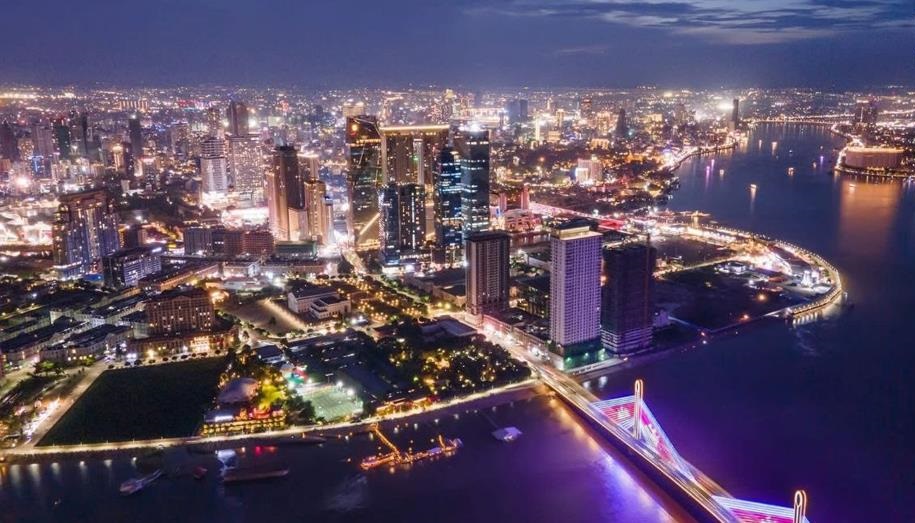
Singapore is a sovereign city-state and island country in Southeast Asia, located off the southern tip of the Malay Peninsula. Known for its world-class infrastructure, efficient governance, and global connectivity, it is a major financial and trade hub linking the Indian and Pacific Oceans.
Key facts
- Official name: Republic of Singapore
- Capital: Singapore
- Area: ~710 km²
- Population: ~6.16 million (2025 est.)
- Government: Unitary parliamentary republic
- Currency: Singapore dollar (SGD)
- Head of state: President Tharman Shanmugaratnam
- Prime Minister: Lawrence Wong
Geography and climate
Singapore comprises one main island and more than 60 islets at the southern tip of the Malay Peninsula, separated from Malaysia by the Johor Strait. The terrain is mostly low-lying, with a central hilly core and extensive coastal reclamation. The climate is equatorial—hot, humid, and rainy year-round—with average temperatures near 27 °C and distinct northeast and southwest monsoon periods.
History
Settled for centuries as part of the Malay world, the island became a British trading post in 1819 under Sir Stamford Raffles and later part of the Straits Settlements. It was occupied by Japan during World War II, then achieved self-government in 1959. Singapore joined Malaysia in 1963 but separated peacefully to become an independent republic on 9 August 1965. Founding Prime Minister Lee Kuan Yew guided rapid modernization and nation-building in the decades that followed.
Government and society
Singapore operates a Westminster-style parliamentary system led since independence by the People’s Action Party. The population is multi-ethnic—about 75 % Chinese, 13 % Malay, 9 % Indian, and 3 % others—with English, Mandarin, Malay, and Tamil as official languages. The national identity emphasizes multicultural harmony, meritocracy, and strong civic institutions.
Economy
With one of the world’s highest per-capita incomes, Singapore’s economy centers on finance, trade, manufacturing, and technology. Its port and Changi Airport rank among the busiest globally. Transparent regulation, low corruption, and pro-business tax policies sustain its role as a gateway for ASEAN and global investment.
Culture and global role
Singapore’s cultural life reflects its diverse heritage through cuisine, festivals, and architecture. It is a founding member of ASEAN and The Commonwealth, hosting major events and institutions that reinforce its influence as a stable, innovative, and cosmopolitan city-state.